Vocabulary Dropout for Curriculum Diversity in LLM Co-Evolution
Randomly masking the proposer's vocabulary keeps self-play curricula diverse and improves the solver by 4.4 points at 8B.
Abstract
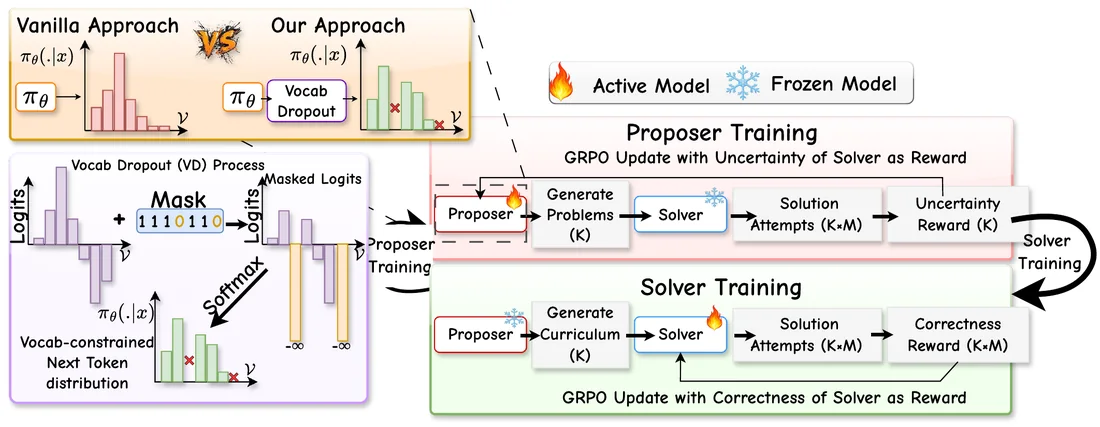
Co-evolutionary self-play, where one language model generates problems and another solves them, promises curriculum learning without human supervision. The promise breaks down early in practice. The proposer converges to a narrow distribution of problems that satisfy the reward function, and the collapsed curriculum teaches the solver little, stalling the loop. We introduce vocabulary dropout, a lightweight intervention that randomly masks the proposer's output logits during both policy training and curriculum generation. The mask is hard and non-stationary, so the proposer cannot lock into fixed token sequences. Training Qwen3-4B and Qwen3-8B on mathematical reasoning via R-Zero, vocabulary dropout sustains proposer diversity throughout training across lexical, semantic, and functional measures, and improves the solver by an average of +4.4 points at 8B with the largest gains on competition-level benchmarks. Explicit action-space constraints, filling the structural role that game rules fill in classical self-play, can keep co-evolution in language productive. Vocabulary dropout is one simple way to impose them.
Citation
@inproceedings{dineen2026vocabularydropout,
  title={Vocabulary Dropout for Curriculum Diversity in LLM Co-Evolution},
  author={Jacob Dineen and Aswin RRV and Zhikun Xu and Ben Zhou},
  booktitle={Conference on Language Modeling (COLM)},
  year={2026},
  url={https://arxiv.org/abs/2604.03472},
}